20
Oct 10

Our Boots

Our Boots

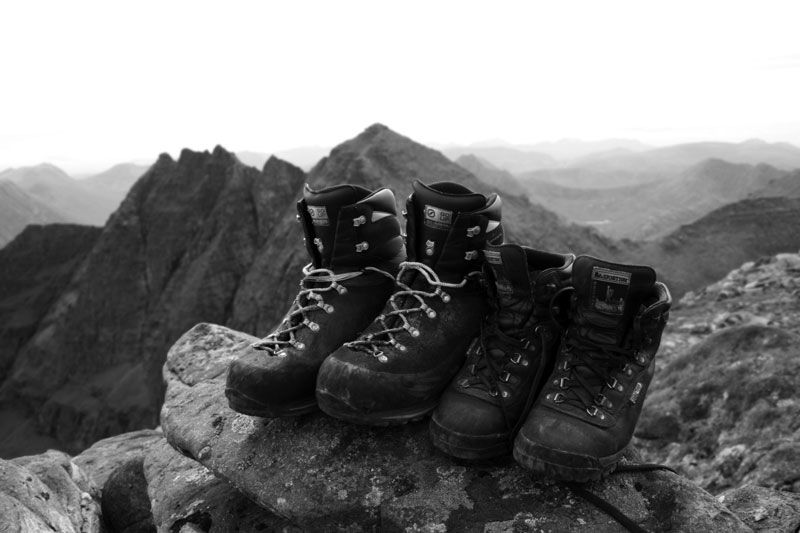
I’ve always liked this photo of our boots I took on An Teallach. It didn’t come out as well as I hoped, but it’s close.

I love how awesomely cute Gina’s boots looks next to mine. Every time I see her boots, it makes me smile, and it was that I was trying to capture in the photo. I will keep at it, and hopefully someday soon, I’ll get the right shot.


26
Sep 10

Freiburg

For reasons that were completely beyond my control I had to leave my beloved London, and move to a much smaller town (technically, it’s actually a city, according to Iest’s definition of a cathedral presence) of Freiburg in southwest Germany.

Having spent my first few weeks here, I think it’s time to list the things I like about it.

1) Freiburg has a very friendly feel to it, people are generally very nice and helpful. The city is very green, not only thanks to its awesome location just on the foothills of the Black Forest, but also in lifestyle – it’s the most bike friendly city I’ve ever lived in. (And my bike is awesome too, and probably will deserve a post on his own.) Also, it is the sunniest city in the whole of Germany, and is right by the French and Swiss borders.

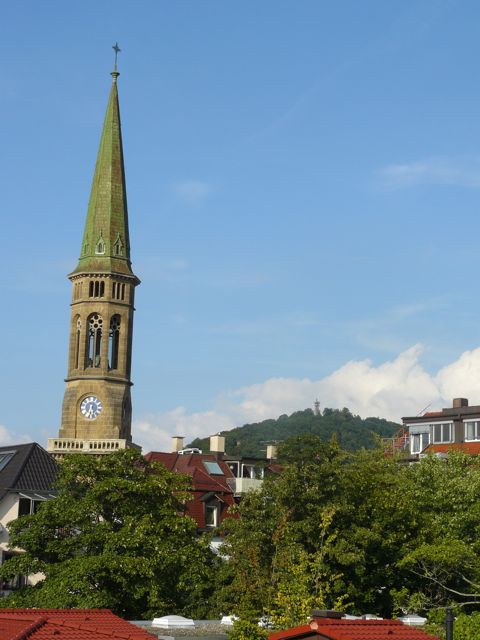
This is the view from my balcony.

My view

Continue reading →


20
Sep 10

Bangor


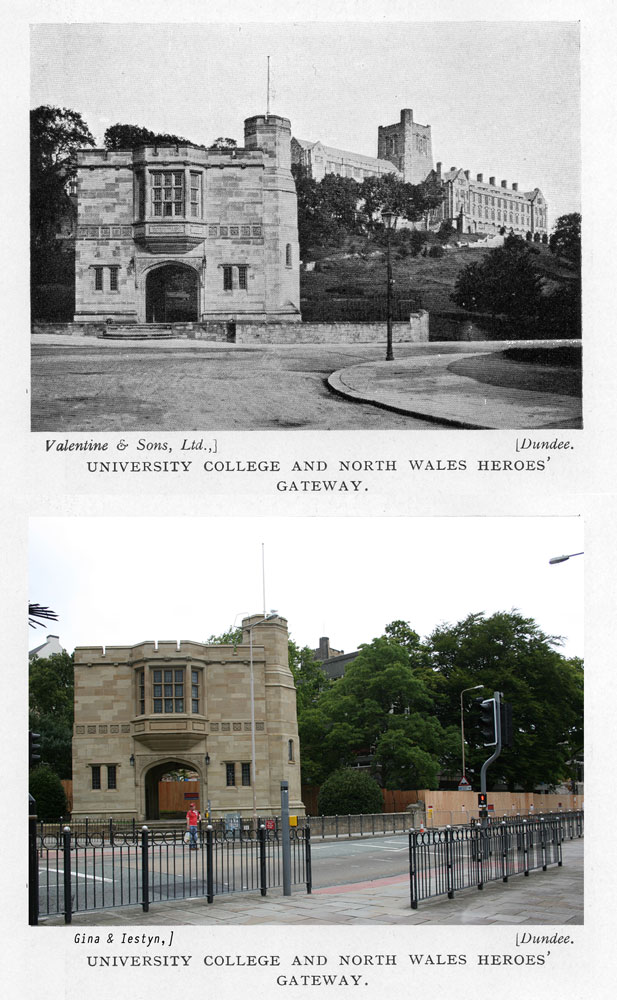
North Wales Heroes' Memorial Archway

Bangor, situated on the Southern coast of the Menai Strait, is one of the most ancient cities in Wales. It’s authentic history begins with the erection of a monastery about A.D. 525, by Deiniol, who became the first bishop of the diocese. The name is by some authorities derived from Ban Chor “the high or superior choir”, the early religious communities having been called circles or choirs, while those which exercised jurisdiction over the less important communities around them were distinguished as high or superior choirs.

In Deiniol Road stands the North Wales Heroes’ Memorial Archway, a Memorial to all the men from North Wales who fell in the Great War. The name of every man from North Wales who fell in the Great War (they numbered 8,500) is inscribed on oak panels in the room above the beautiful Tudor archway. It is one of the most impressive War Memorials and the panelled room, with it’s bronze doors, is particularly worth a visit.

Well, I never knew that this Archway was a memorial for the Great War. I used to drive pass this, even walk under it every week, and never once stopped to look at it, and see what it was all about. It sounds quite impressive inside, I wonder if it’s still open to the public?!


18
Sep 10

Scottish Panoramas

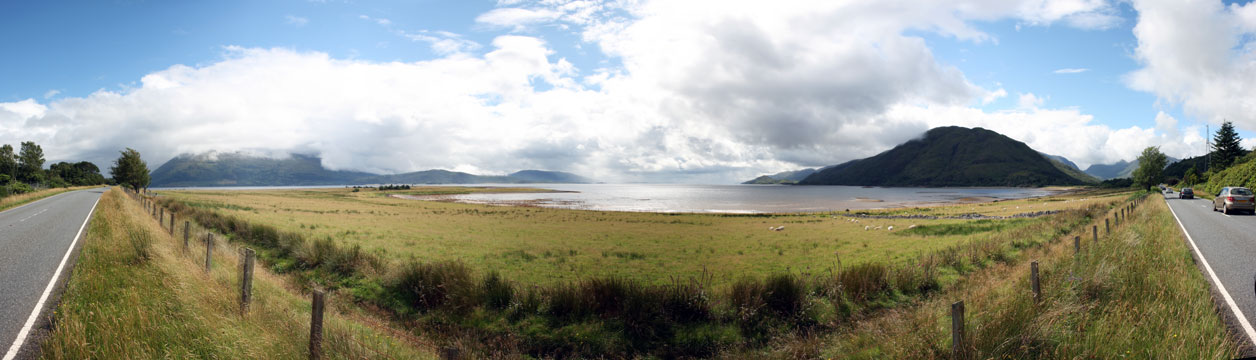
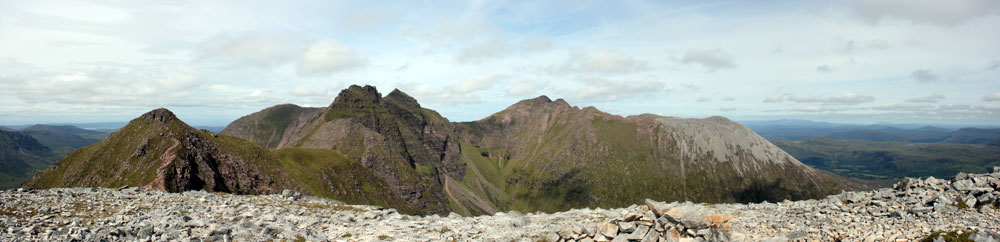
Everywhere I go, I take potential panorama pictures – and Scotland was no exception. Here are a few that worked quite well;

A pretty Scottish beach

Gina on top of Ben Eige Massif

An Teallach Massif

An Teallach Main Ridge

Glen Lyon

Good times. The panoramas I take are made from up to anything between 10-15 photographs.


29
Aug 10

Beddgelert

Aberglaslyn pass

Our new (old) awesome North Wales guide book doesn’t have a picture of Beddgelert itself. It does, however, tear apart the great legend of the place:

It seems cruel to spoil a pretty story, but truth must be told. About fifty years ago a writer is Welsh magazine showed that the legend was not founded on fact, and the Rev. A. Elvet Lewis, in a work published in 1899, entitled Bedd Gelert: Its facts, Fairies, and Folk-lore, gives wider publicity to its origin. He shows that the story, so far as it has local colour, is a growth of the nineteenth century; that before 1798 it was unknown in the neighbourhood; and that it was, in all probability, imported from South Wales by a certain David Prichard, who migrated north and became the first landlord of the Royal Goat Hotel at Beddgelert. Prichard came stocked with good stories from the southand among them was that of ‘the man who killed his greyhound’. He it was who fitted this particular folk-tale to the scene, and the dog to the name of Gelert; he who told the story to Spencer, the author of the familiar ballad; and he who, with the artistic completeness of the born myth-maker, aided by the parish clerk and another, raised the stone now exhibited on the spot known as the grave.

So there it goes. Legend gone. The tomb stone is still there though.
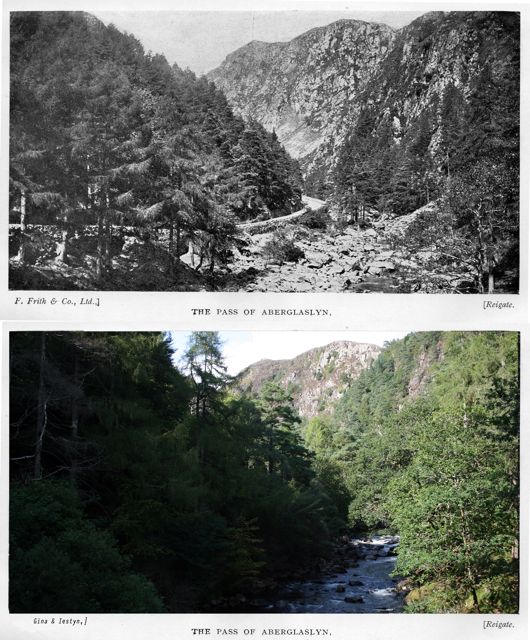
And a charming walk from there still takes you to the Aberglaslyn pass, just as all those years ago, and it even looks quite the same, except the trees have grown a lot.

…looking back from the romantic Pont Aberglaslyn we have an uninterrupted view of naked brown precipices rising to the sky beyond the fir trees and the dashing stream at our feet. (Teas and refreshments may be obtained at the bridge.)


28
Aug 10

Menai Bridge

Menai Bridge

Tolls: Foot passengers, 1d.; motor-cycle and side-car, 6d.; motor-cars seating no more than 3 persons, 1s 2d., seating 3-6 persons 1s. 9d. All these tolls are for the double journey.

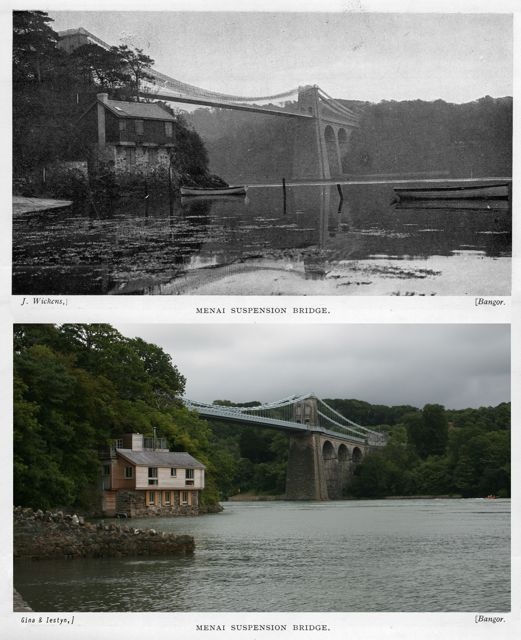
This bridge, which spans the strait at a point 1 1/2 miles from Bangor station, carries the road.

Up to the beginning of the nineteenth century, ferries, five in number, afforded the only means of communication with Anglesey; but owing to the inconvenience and danger to which travellers were exposed, the attention of the Government was seriously directed to the matter, and, Telford’s plans for the bridge having been approved by Parliament, its construction was begun in 1818, and on January 30, 1826, it was opened. Its actual cost was £120,000, and the sum of £26,577 was awarded to the owners of the superseded ferries. The roadway is 100 feet above the surface of the water at the highest tides; the distance between the points of suspension is 560 feet, and the total length of the roadway is said to be 1,000 feet. Only four fatal accidents occurred among the workmen engaged in the erection of the bridge, and those who lost their lives represented the four nationalities included in the United Kingdom.

Coincidence? I don’t think so! In any case useful trivia in case this question ever came up in the Thursday pub quiz. Also, the house by the bridge looks totally awesome now!


27
Aug 10

Caernarfon

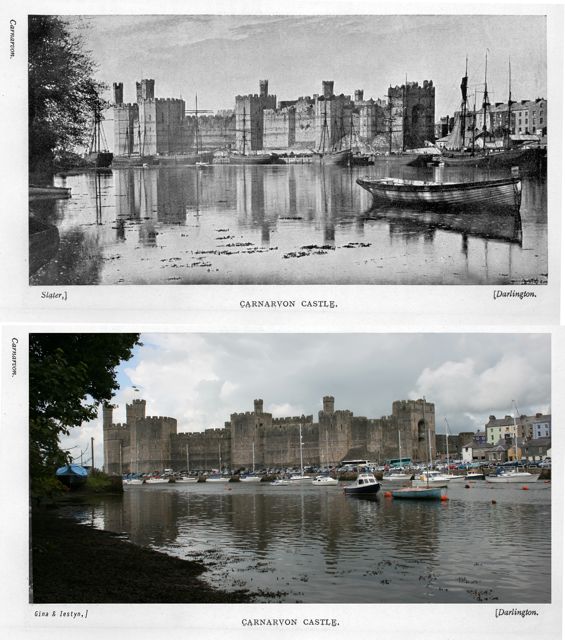
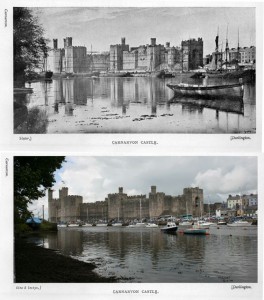
Caernarfon castle through ages

or Carnarvon, as per our awesome guide, had to be the first stop in our retro-project.

Caer-ar-fon “the fortress opposite Anglesey” stands just within the western entrance to the Menai Strait, at the mouth of the river Seiont. It is the ancient “metropolis of the hills” – the chief town in that mountainous stronghold known as Eryri, and the best view of the town (that from the path leading to the Baths) still shows the stout little fortress backed by the wild and rugged giants of Snowdonia. Carnarvon is the best modern representative of the British fortress Caer Seiont, and of the Roman military station, Segontium, and in position, beauty and historic associations there are few towns, if any, in Wales to compare with it.

Yes, yes, that’s quite right. In fact, there are few towns altogether, not only in Wales, that can compare to Caernarfon. Also, the seagulls. The guide doesn’t mention them, but we love them, and love to be woken up by their cries early in the morning. (Yes, we.) So what does the guide have to say about the castle?

Admission – sixpence; children 3d.; parties over 20, 3d each.
Open daily 10-8 or dusk, Sundays from 12 noon to 6 or dusk if earlier.
Entrance by King’s Gate, on north side.

With the exception of that in Alnwick, in Northumberland, Carnarvon Castle is “the finest in Great Britain”. Dr. Johnson, who visited in 1774, observed in his diary: “The Castle is an edifice of stupendous magnitude and strength. To survey this place would take much time – I did not think there had been such buildings; it surpassed my ideas.”

Seriously, a sixpence? The prices have gone horribly up, haven’t they? They made me pay like a fiver. Worth it though. Specially up the towers – everybody should do that. And who ever heard of Alnwick?
10
Aug 10

Glen Lyon – Wales

The weather forecast for the remaining couple of days was a bit rainy, so we decided to go to Wales, and spend the rest of time there. (Plus, I really wanted a Welsh dragon key-ring, which at the end proved to be more of a hassle than I would ever expected in a profoundly Welsh-proud place like Caernarfon, so it was good there was enough time for that. Caernarfon failed completely (all they sell is plastic kitschy stuff), and Beddgelert had to come to rescue.)

We visited Edinburgh, which was hosting it’s famous Fringe Festival, so it was full of people, but also nice and sunny, and also it was the place of the best find of the trip – an old North Wales guidebook from early 1930s. Yey! It was in a tiny little second-hand book shop for £4 (well, originally, it was for £5, but it wasn’t quite clear whether the 5 was a 5 or a 3, so we settled on a fair price of £4). For the record, it is also important to state that it was me who found it, and it’s mine mine mine, no matter what Iestyn says (and no matter that he actually paid for it, as they didn’t take cards and I didn’t have change).

The guide is awesome, and it is much fun to read the description of our favorite Welsh places, and see what they looked like ages ago. The book also contains fold-out maps, and generally it is beautiful all over. For our next project, we decided to try and re-take the pictures from the book, to see how the places look today. Taking those pictures also kept us entertained for a couple of days in Wales, until we had to go home to London, and our epic trip was over.


09
Aug 10

Skye – Glen Lyon

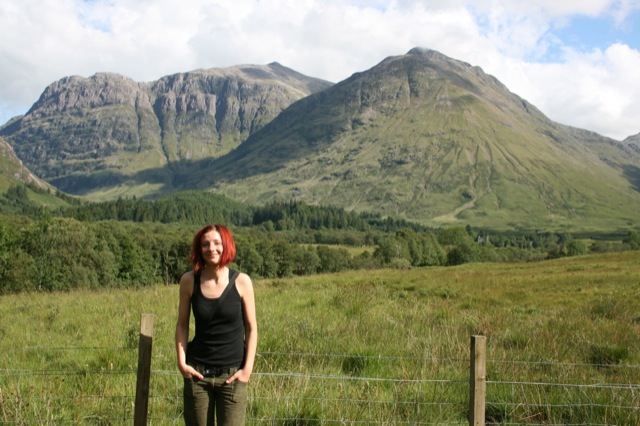
Gina and Glen Coe

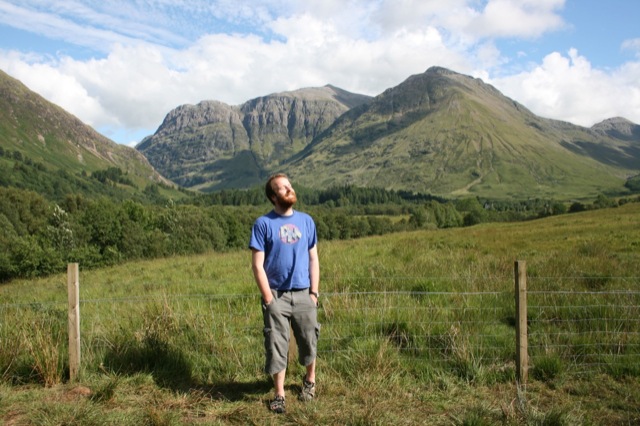
Iestyn and Glen Coe

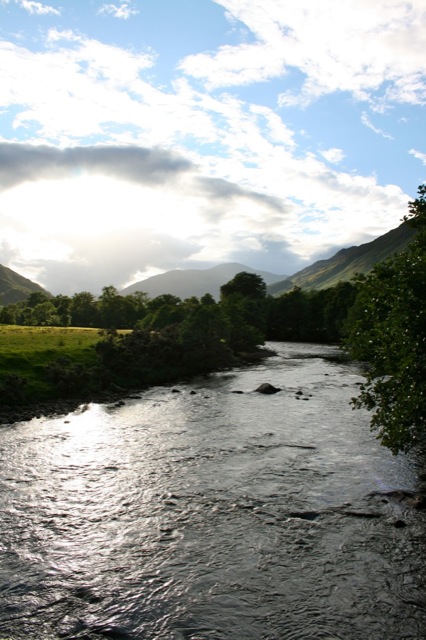
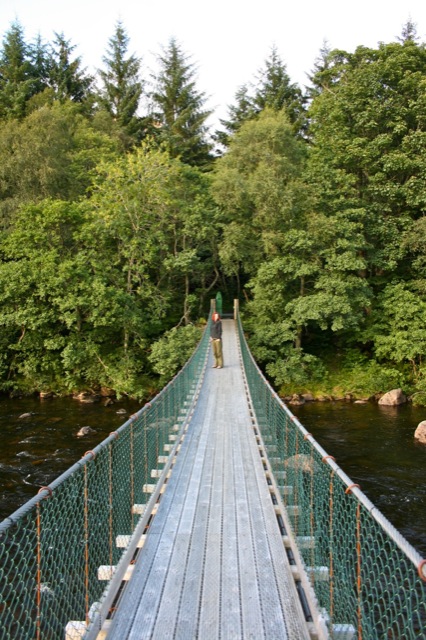
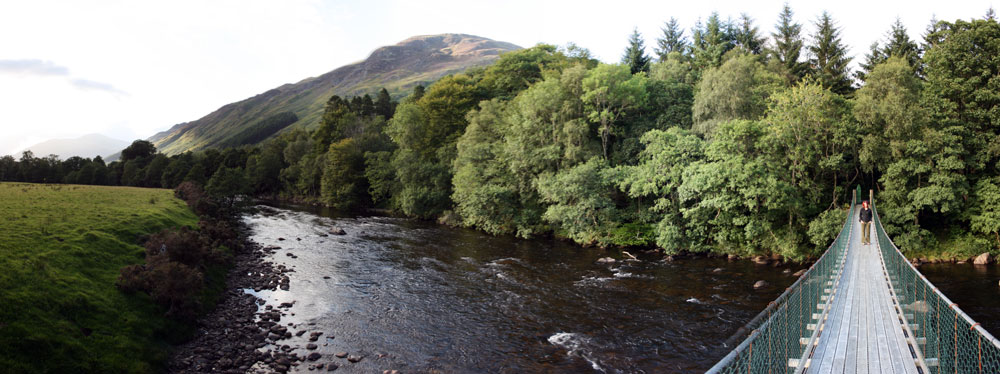
Out of rainy Skye (is there ever sunny at that place?), down to the beautiful Loch Tay area, very very scenic (and yes, sunny). Awesome glen around Ben Lowers and of course, Glen Lyon. Very relaxed day with some awesome views. Castle Menzies. The area is a little bit posh though, one campsite replaced by holiday condos, so we had to go to another one. It was good anyway, as it had lots of cute ducks around.

Glen Lyon

Glen Lyon

Glen Lyon Panorama


Wildlife sightings:
mole
deer
ducks


08
Aug 10

Ullapool – Skye

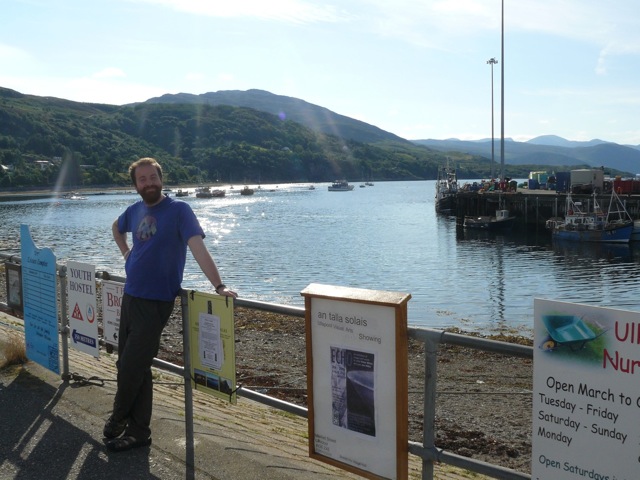
Port of Ullapool

Properly sunny! Just the day to finally do the An Teallach route, yes, the UK # 1 route by Trail magazine. We wasted no time in Ullapool, and soon we were on the trailhead. The weather was exquisite indeed, and after a bit of a strenuous rocky uphill hiking we got to enjoy the beautiful views we came for. Of course, due to the weather and popularity of the route, it was a bit of a bloody tourist highway that day, but still very worth it.

We started the ridge with Sail Liath, continued over Stob Cadha Gobhlach, Corrag Bhuidhe, Sgurr Fiona, Bidein a Ghlas Thuill and Glas Mheall Mor. The final descent through the valley was very beautiful, along waterfalls and rhododendron bushes towards the end, but proved to be a bit too long and strenuous after what we had already done on the ridge, and we arrived to the car very exhausted. A little bit over 7 hours in total.

[simpleviewer gallery_id=”30″ bgcolor=”eeeeee” gallery_width =”100%” gallery_height =”800″]
After nice Chinese dinner in Inverness, we wanted to camp in Tokavaig on Skye, but that proved too spooky for this time, and since it started to rain heavily, we just decided to sleep in the car for once.

Wildlife sightings:
mountain goats
frogettes
butterflies